Technology Q&A
What makes our systems different?
Concept
How the fiber-feedback OPO works
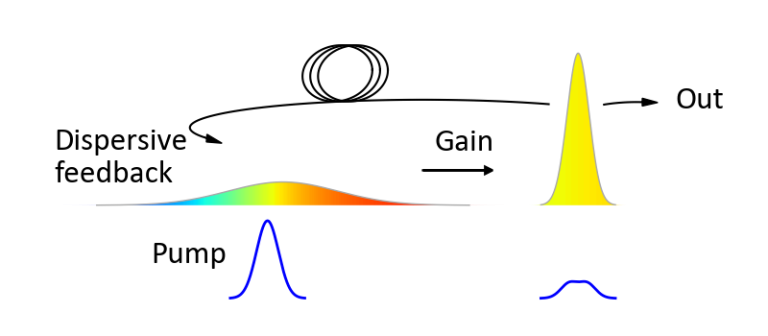
Our frequency converters are fiber-feedback optical parametric oscillators (FFOPO): an OPO cavity that combines an intra-cavity single-mode fiber with a bulk nonlinear crystal that provides parametric gain.
The fiber serves two roles. It guides only the fundamental transverse mode, giving a clean, repeatable TEM00 beam with fixed pointing; and its dispersion stretches the recirculating pulse in time. Because the wavelength that is amplified is set by the pump’s arrival time rather than by a finely tuned cavity length, the FFOPO is far less sensitive to drift. Depending on wavelength, it is 20 to 100x less sensitive to temperature than a conventional OPO, which yields correspondingly slower wavelength drift.
In day-to-day operation the oscillator therefore runs without active wavelength locking: no piezo loops, highly repeatable wavelength settings, and a compact footprint. Pump sources include femtosecond and picosecond solid-state and fiber lasers.
Architecture
Why SI technology?
Fiber lasers
Quantum cascade lasers
Conventional OPOs
SI technology
High RIN due to ASE and gain dynamics
Very high RIN (pulsed)
Moderate RIN (cw)
RIN set by pump laser;
Lock electronics add noise
RIN fully set by pump laser
Cavity re-locking or recalibration
Passive dispersive tuning
Passively stable
Electronically regulated.
Electromechanical with optical instrumentation and PID-feedback
Passively stable
Amplifier ASE; Higher order dispersion
ASE background
Nonlinear gain process
Nonlinear gain process
Changes upon tuning
Alignment-dependent
Cleaned by fiber
Contact
Contact us
Phone+49 (0)711 3420325 0
AddressSI Stuttgart Instruments GmbH
Ernsthaldenstr. 17, 70565 Stuttgart, Germany